You probably assume that the harder and more impressive a task is, the more it deserves to become a Skill.
The opposite is often true. What is really worth packaging is usually the kind of tiny nuisance you can barely be bothered to explain and might even feel silly mentioning—precisely because it is so trivial that you have to brief the AI all over again every time.
Let us break that down.
The One-Sentence Standard: Package It Once, Use It Repeatedly
Imagine that a new colleague joins your team. They are brilliant and can do almost anything, except for one flaw: they cannot remember your company's rules.
Every time you assign a task, you have to explain everything from scratch—which columns a spreadsheet needs, which checks an editorial review must include, and how files should be named. They do an excellent job, but you still have to repeat the explanation next time. By the tenth round, would you not be losing your mind?
A Skill is the cheat sheet you hand them. What belongs on that cheat sheet is the set of rules and steps you must explain every time and that they could never infer on their own. Write it once, and they can carry it with them from then on.
Does that mean any task can become a Skill? Not so fast. It first has to pass two tests. Only work that passes both is worth the effort.
Test One: Is This Something Only Your Team Knows?
Think of any task—say, "make this paragraph read more smoothly."
Stop there. Everyone can do that, and AI can already do it out of the box. Packaging it is pointless. Putting something it already knows into a cheat sheet is like teaching a fish to swim.
So what is worth capturing? The things it cannot guess and can only learn from you: the bizarre spreadsheet template only your department understands, the exacting editorial rules your chief editor insists on, or the finicky naming convention used by your archive.
In one sentence: cross out what everyone knows; keep what is unique to your team.
Counterexamples
| Example | Explanation |
|---|---|
| "Please make this email sound more polite." | AI can already do this; it does not need to become a Skill. |
| "Give me ten more compelling titles for this article." | This is a general writing capability; it does not need to become a Skill. |
| "Translate this paragraph into English." | Unless your team has its own terminology and translation rules, this does not need to become a Skill. |
Good examples
| Example | Explanation |
|---|---|
| "Every week, turn the client-visit notes sent by sales colleagues into the six fixed fields in our CRM." | Only your team knows the field names, merge rules, and how missing information should be marked. |
| "Before publishing a Practice article, check the title, summary, series/order, unpublished links, and MOCK markers against our own checklist." | This is not ordinary proofreading; it is your site's own publishing procedure. |
| "Rewrite a candidate's interview feedback into the standard wording that an HRBP can forward directly." | What may be said, what must be toned down, and how conclusions are arranged are communication boundaries specific to your company. |
Test Two: Can You Explain in One Sentence When It Should Be Used?
This is the easiest test to overlook, yet it is crucial.
Once a Skill is installed, it does not wait for you to call its name—the AI decides for itself when to pull out that cheat sheet. What does it use to decide? The usage description you wrote.
You therefore need to be able to say clearly: "Use it when I need to do XX." If that sentence is clear, the Skill appears when it should. If it is vague, the cheat sheet sleeps in a pocket and is nowhere to be found when needed.
Try saying that sentence about your own task. Stuck? Then it has not passed this test.
Counterexamples
| Example | Explanation |
|---|---|
| "Build a Skill that helps me with content operations." | This is too broad. Does it cover topic selection, editing, scheduling, or pre-publication checks? AI cannot know when to use it. |
| "Help me improve the quality of customer communication." | The triggers are scattered across presales emails, meeting minutes, and complaint replies; these are not one task. |
| "When I find a writing task difficult, help me decide how to write it." | This first depends on you deciding that the task is difficult, so AI cannot determine when to step in on its own. |
Good examples
| Example | Explanation |
|---|---|
| "Use it when I need to turn a customer interview recording into product-requirement cards." | The scenario, input, and output are all clear, so AI knows when to use it. |
| "Use it before I publish a Practice-series article to check frontmatter, series/order, unpublished links, and MOCK markers." | The trigger is the pre-publication check. |
| "Use it when I need to turn interview feedback into a version an HRBP can forward." | It does not apply to all interview work, only to the step where feedback is rewritten. |
One More Hidden Test: Do You Do This Often?
Even if the first two tests pass, do not celebrate yet.
Look back and ask: how often do you do this? If it happens only once a year—such as filling in an annual form—turning it into a Skill gains you little. By the time you need it next year, you may have forgotten that you installed it.
It only pays to package work that you repeat so often your hands ache from doing it.
Counterexamples
| Example | Explanation |
|---|---|
| "At the end of every year, turn the department budget spreadsheet into the version the boss wants." | You do it only once a year, so you may forget the Skill exists before you need it again. |
| "Write a full set of emcee lines for this year's company party." | This is a one-off task with no value from repeated invocation. |
| "Research whether we should enter the Japanese market." | This is more like one-time research before a decision than a fixed process that will run repeatedly. |
Good examples
| Example | Explanation |
|---|---|
| "Every day, classify customer-support tickets as product, operational, or emotional issues." | It is frequent and repetitive, and the classification rules are stable enough to capture. |
| "Every week, turn sales-visit notes into the fixed fields in our CRM." | It happens weekly and follows the same fields and rules every time. |
| "Before every Practice article is published, check frontmatter, series/order, unpublished links, and MOCK markers." | The check repeats whenever an article is published, so the frequency is high enough. |
Apply the Tests to Your Own Work, and Only a Few Outcomes Are Possible
Those are the rules. Now run the task in your head through the two tests, and it will end up in one of a few places:
| Outcome | What to do |
|---|---|
| Passes both tests | Do not hesitate. This is the one—start building it. |
| Fails the first test | AI already knows how to do it, or it depends entirely on your intuition with no rules to teach. Cross it out immediately; it is not Skill material. |
| Fails the second test | If you cannot say when it should be used, the task itself probably has unclear boundaries. Practice first with something clearly defined. |
| Partly passes and partly fails | Do not discard the whole thing. Split it: turn the part governed by hard rules and precise timing into a Skill, and keep the part that requires your judgment for yourself. |
The final outcome is the most common and the most valuable, so the next section focuses on it.
One Skill Should Do One Thing
You may be tempted to build an all-powerful super-Skill that can do everything.
Do not. For a giant tool that claims to do everything, the sentence explaining "when to use it" becomes impossible to write. Think about a colleague who says they can do anything: you may actually have no idea what assignment to give them. AI will either use such a Skill at random or never use it at all.
The smaller the scope, the more accurately it can be invoked. Start with a small action that takes three sentences to explain and repeats several times a week. One Skill should bite down on one task and refuse to let go.
Leave These Tasks Alone for Now
Following the logic above, some kinds of work inherently fail the tests. Give up on them early:
| Type | Why to leave it alone for now |
|---|---|
| Things AI already knows how to do | Teaching it something everyone knows is wasted effort. |
| Things based entirely on intuition, with no articulable rules | If you cannot explain the method behind creativity or quality judgments, what could you put on the cheat sheet? |
| Things you do only a few times a year | You will not remember to use the Skill after installing it. |
| Things that require your personal approval | Setting direction and making decisions are your responsibility; a cheat sheet cannot replace you. |
Now hand the judgment directly to AI.
Let AI Decide Directly
First, Install skill-content-fit
Copy this:
Install the skill-content-fit Skill from the Tranfu library into this project.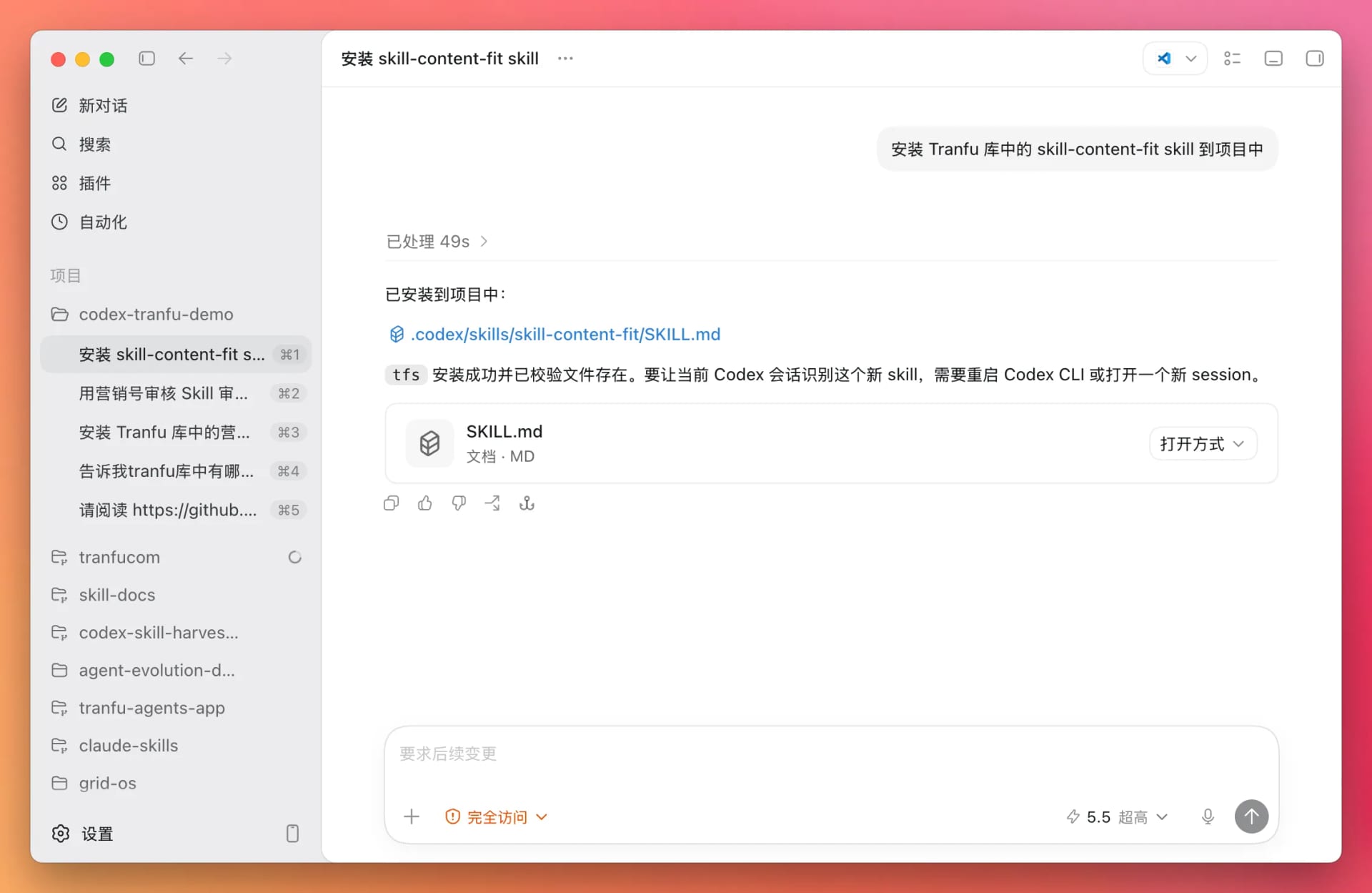
Then Send It Your Example and Ask for a Judgment
Counterexample
Copy this:
Is this suitable for a Skill?
---
After last week's product review, everyone assumed someone else would follow up. As a result, three action items had no owner and the project was delayed by two days.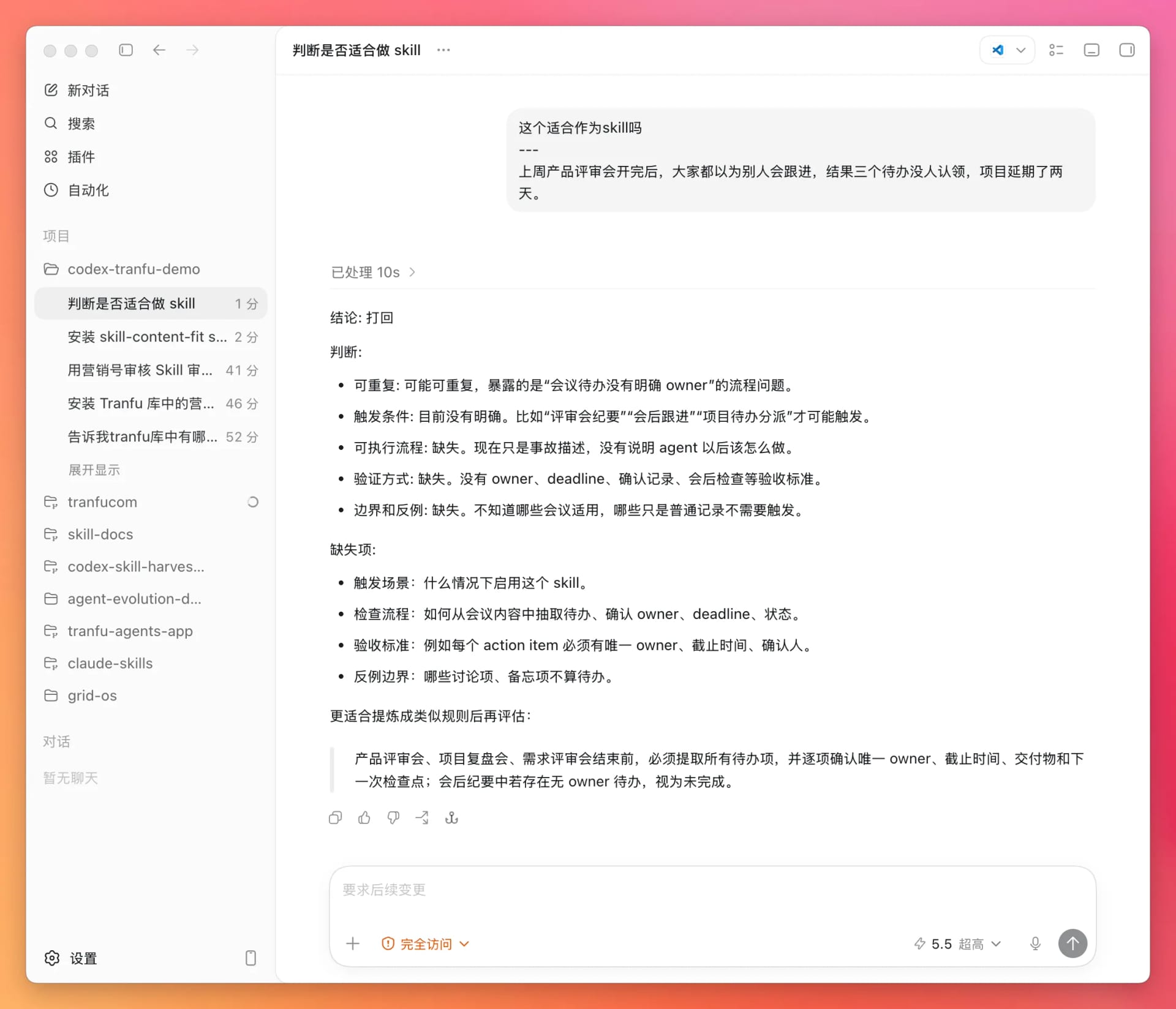
Good Example
Copy this:
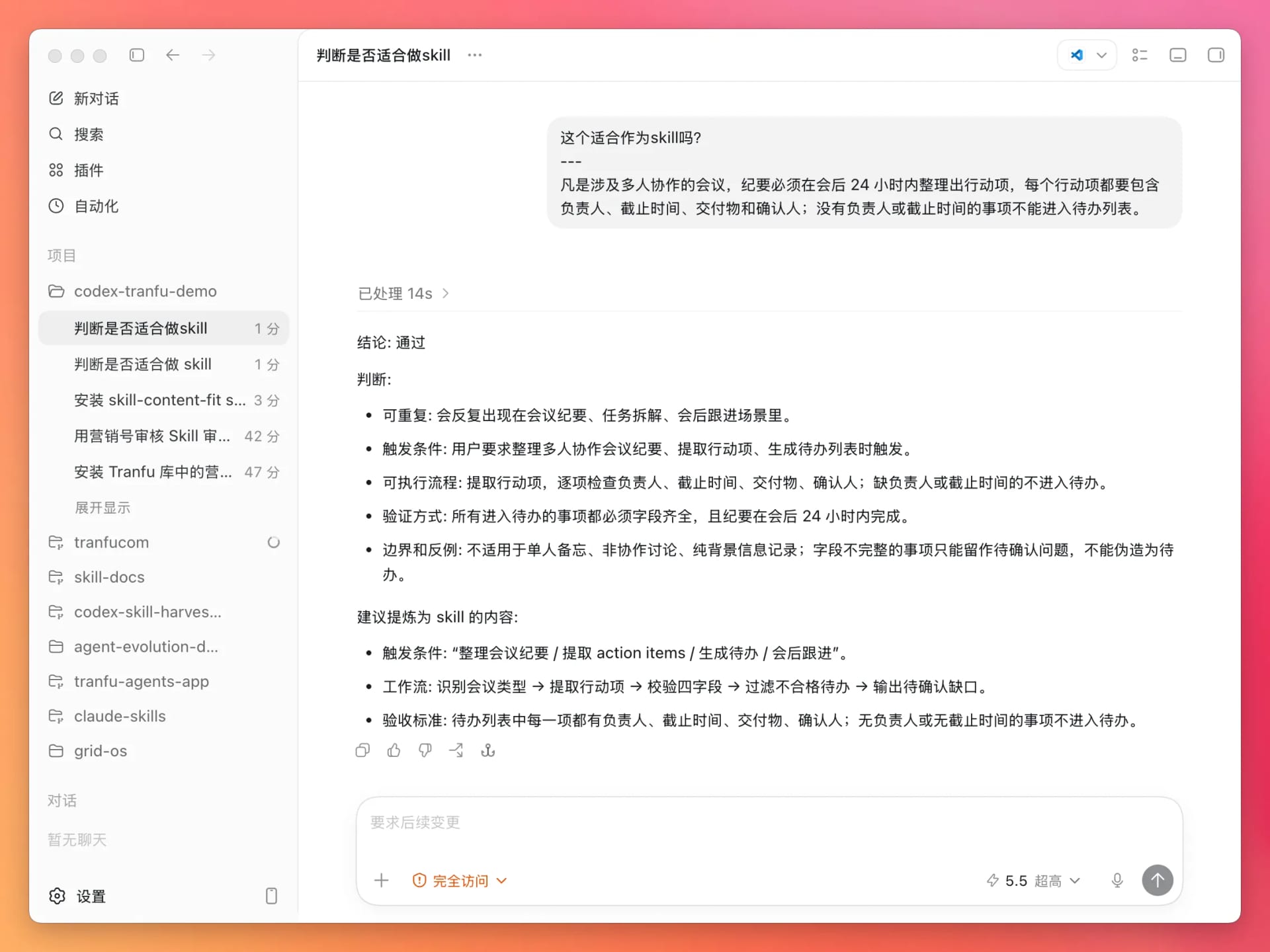
Is this suitable for a Skill?
---
For every meeting involving multiple collaborators, the minutes must be turned into action items within 24 hours. Every action item must include an owner, deadline, deliverable, and approver. Items without an owner or deadline must not enter the to-do list.